
Gate Openers Installed and Repaired in Ann Arbor
Swing-arm, linear, underground and sliding-gate operators wired and set up, and openers that stall, hum or reverse traced back to their cause.
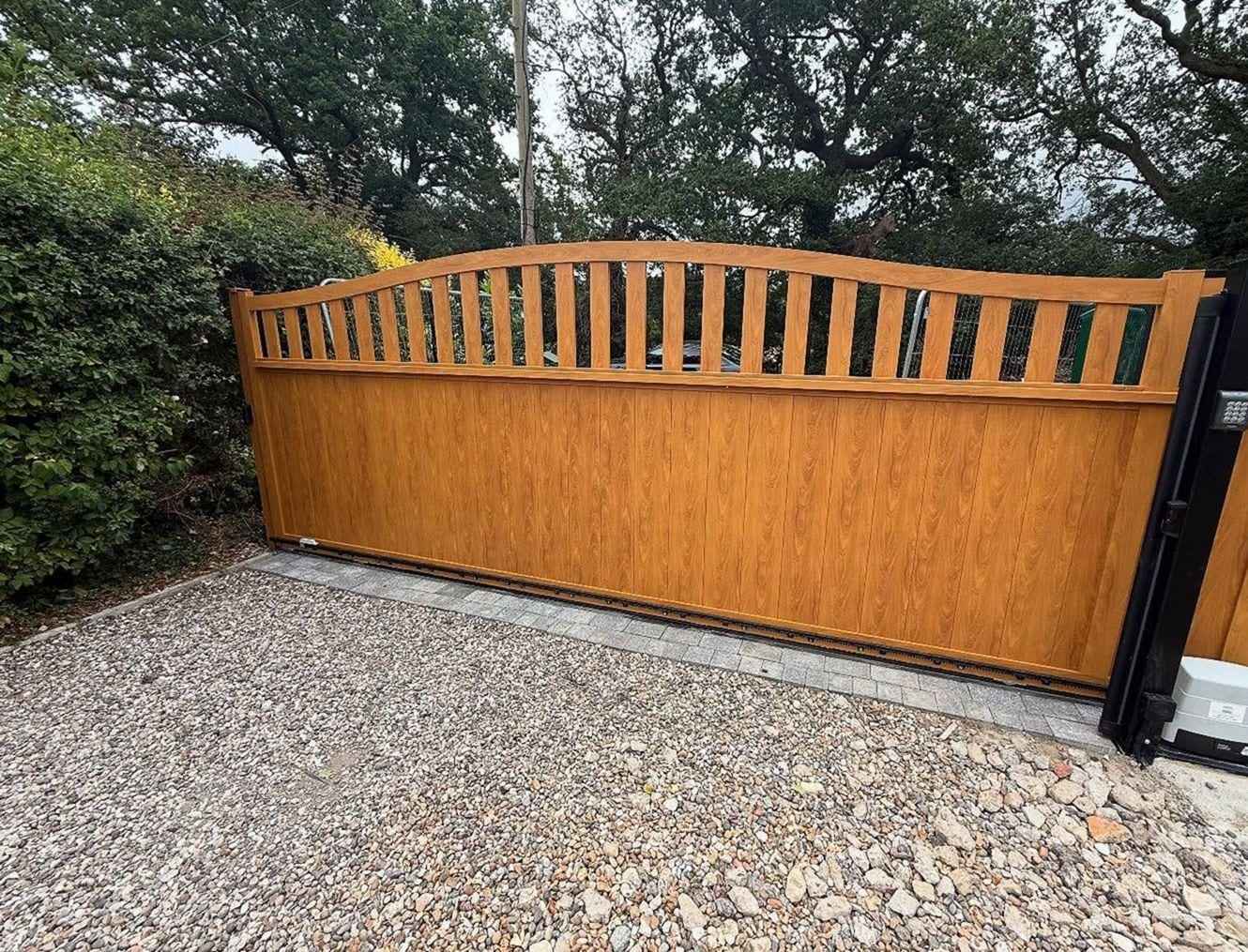
Signs an Opener Needs Attention
An opener rarely quits without warning. It slows, hesitates or starts reversing for weeks before it stops for good. Any of these is worth a look:
- The gate stops partway, or stops at a different point each time.
- The remote does nothing, though the keypad may still work.
- The motor hums or clicks, but the gate stays put.
- The gate reverses with nothing in its way.
- The gate moves slowly or jerkily, or speeds up and slows down along its travel.
- The operator grinds, knocks or runs hot after a cycle.
Many of these start at the gate, not the motor. A gate that binds on a worn hinge or roller makes the operator work harder until it trips its own force setting and stops. Slow runs, random stops and sensors that trip for no reason usually come down to alignment, wiring or a limit setting that has drifted. A gate that won’t move easily by hand needs gate repair before anyone adjusts the opener.
Opener Types
On a swing gate the operator is usually an arm between the post and the leaf. On a sliding gate it is a box at one end of the opening that drives the gate along. Which one fits depends on the gate, the posts and how much of the machinery should show.

| Opener type | Gate it suits | What to know |
|---|---|---|
| Swing arm (articulated) | Swing gates on wide brick or stone piers, where the hinge sits back from the pier’s face. | The arm folds like an elbow, so it works where a straight arm would not fit. It needs room on the inside of the post and stays in view. |
| Linear ram | Swing gates on slim posts, with open ground beside the hinge. | A straight arm pushes and pulls the leaf. It must sit at set distances from the hinge to open the gate fully, and its moving shaft should stay clear of grit. |
| Underground swing | Swing gates where nothing should show at the post. | The motor sits in a buried box under the hinge. The box needs a drain: one that fills with spring rain and then freezes stops the gate and can ruin the motor. |
| Sliding-gate rack operator | Sliding gates on a track and cantilever gates. | A motor on a pad at one end turns a gear along a toothed rack fixed to the gate. Gear and rack have to stay in mesh the whole way; a rack that sags or a pad that shifts makes the gate jerk. |
| Solar-assisted | Any of the above, where running a power line to the gate is hard. | A panel charges the opener’s battery. Whether it keeps up depends on how often the gate runs and how much sun reaches the panel on short winter days. |
Installing an Opener
An operator can only move a gate that already moves well. Before one goes on, the gate should swing or slide easily by hand, level and without tight spots. A motor fitted to a gate that binds hides the fault for a while and wears itself out against it.
Haisley Gate Services wires automatic openers and programs the keypads, remotes and safety sensors that go with them. The work on a new opener usually covers:
- the operator mounted on its post, pad or pier, lined up with the gate’s hinge or rack;
- power and control wiring run in conduit, with the control box set where it stays dry;
- open and close limits set, so the gate stops at the same points every time;
- force and auto-reverse set, so the gate stops and backs off when it meets something;
- photo eyes, and safety edges where the gate needs them, placed across its path for entrapment protection;
- remotes and keypads programmed, and the whole system tested before the gate is handed over.
The photo eye is the part most people never notice: a small sensor on a post or pier that watches across the opening. When something breaks its beam while the gate is closing, the gate stops and reverses.

Opener Repairs
Haisley Gate Services repairs burned-out operator motors, but the motor is rarely the first thing to check. Most opener faults fall into a short list:
- Limits that have drifted. The gate stops short, runs past its stop, or halts at a different point each time.
- Sensors out of line. A photo eye knocked a few degrees, or caked with dirt, tells the operator something is in the way.
- Wiring. Cable nicked by a shovel, chewed or corroded at a terminal gives stops and dead remotes that come and go.
- Worn gears and arms. Stripped gears, a worn rack or a loose arm bracket give grinding and jerky runs.
- The motor. A motor that hums without turning, or has burned out from pushing a binding gate, is repaired or replaced.
Drifting limits and dirty sensors are the kind of fault gate maintenance catches before the gate stops in the driveway.
The Manual Release
Every gate operator has a manual release: a key, lever or knob that disconnects the motor from the gate so the gate can be moved by hand. In a power outage with no working backup battery, it is the only way to open the gate, so it pays to know where it is before it is needed.
Keep the release key somewhere other than the car parked behind the gate. Release the gate only when it is standing still, and keep a hand on it on a slope, because a released gate can roll or swing under its own weight.
When the power comes back, lock the release again. Many operators then make one slow run to find their limits; let it finish, and stay out of the gate’s path while it does.
Remotes, Batteries and Power Outages
Why does the remote only work close to the gate?
Usually a weak battery in the remote. If a new battery does not help, the receiver’s antenna may be loose, damaged or blocked, or something nearby is crowding the signal.
A keypad that still works while every remote fails points to the remotes or the receiver, not the motor.
What happens to an automatic gate in a power outage?
Without a backup battery the gate stays where it is, and the manual release is the way to move it. With a backup battery in good health, most operators keep running for a limited number of cycles, and some can be set to open the gate and hold it open when the battery runs low.
A backup battery wears out with age even when it is seldom used, and a tired one often shows itself only when the power drops.
Can a lost remote be shut out of the opener?
Yes. The receiver’s memory can be cleared and the remotes still in hand programmed again, so the lost one stops working. Keypad codes can be changed the same way, along with the rest of the keypads and intercoms at the gate.
Is it safe to keep using a gate that reverses for no reason?
It reverses because it senses something in the way, or because the gate meets more resistance than its force setting allows. Wipe the photo-eye lenses and check that nothing sits in their beam.
Never turn the force up or bypass the sensors to make it close. Those settings are what stop the gate on a car or a person. If it keeps reversing, keep people clear of it and have it looked at.
A Gate That Opens on the First Press
Say what the gate does when the remote is pressed, and whether the keypad does the same. That points the visit at the right part.